Project aims
The cICMs project aims to obtain causal evidence on the functional roles of ICMs. We use multi-site interventions to manipulate phase and envelope coupling and test the impact on stimulus processing and behavior. We investigate ICMs during tasks in order to test differences between both types of ICMs regarding their relation to cognitive processing. Furthermore, we aim to unravel potential interactions between phase and envelope ICMs.
Importantly, we aim to develop a coherent framework for multiscale coupling dynamics. Modeling and information-theoretic analyses of the experimental data serve to integrate the results across scales and species and, thus, to derive a unified framework for multiscale coupling dynamics.
Hypotheses
The central hypothesis of this project is that both types of ICMs have causal relevance for cognitive processing and behavior. Phase ICMs have been proposed to enable communication between neuronal populations in a spatiotemporally precise manner and to serve for flexible routing of signals. Envelope ICMs, in contrast, may couple excitability fluctuations between neuronal populations and, thus, regulate their recruitment into the same cognitive process or task.
What is currently lacking is a research program that puts these different coupling modes in a unifying perspective. The overarching goal of this project is to provide such an integrated view.
Approaches
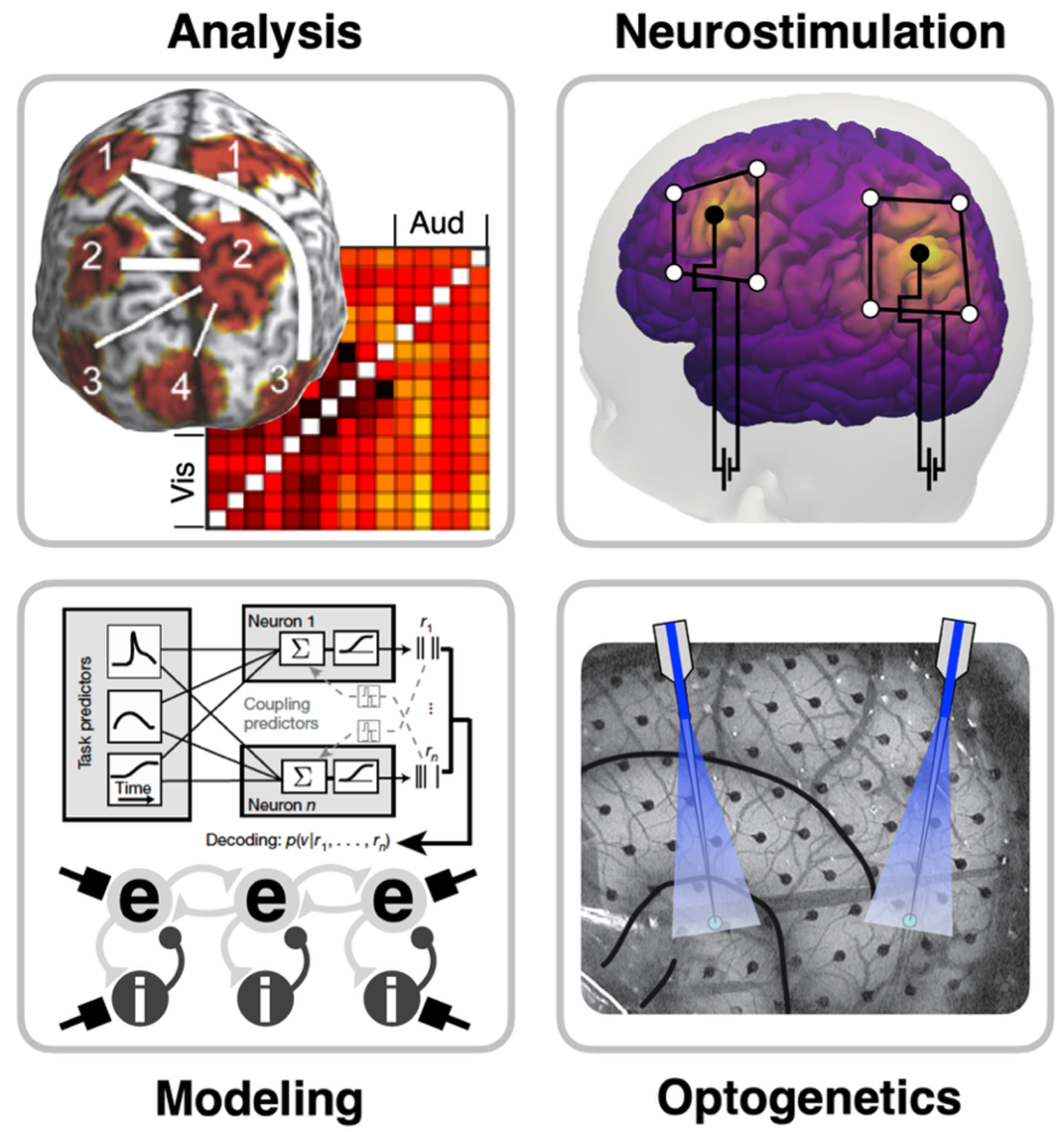
To achieve the project objectives, we apply a translational approach which combines EEG and MEG recordings in humans with invasive recordings in ferrets. The human MEG data will provide insights into ICMs underlying cognitive processes, which will then be manipulated by noninvasive electrical neurostimulation. Ferrets provide a highly suited animal model which allows high-resolution recordings and targeted optogenetic manipulation of ICMs. We combine our experimental investigations with multiscale modeling and information-theoretic analyses of the relation of ICMs to behavior.